flowchart LR
  classDef step fill:#f5f7fa,stroke:#5c6b7a,color:#1b3a57,stroke-width:2px;
  classDef tune fill:#BF281B,stroke:#BF281B,color:#ffffff,stroke-width:2px;

  A["Blocks<br/>(plain R functions)"] --> B["Spec function<br/>create_keras_*_spec()"]
  B --> C["Workflow<br/>recipe() + workflow()"]
  C --> D["Tuning<br/>tune_grid()"]
  A -. "args → tunables<br/>num_{block} repeats" .-> B

  class A,B,C step;
  class D tune;
kerasnip: A Bridge Between ‘keras’ and ‘tidymodels’
Madrid R Group | February 2026
kerasnip v0.1.0.900
Docs: davidrsch.github.io/kerasnip · Repo: github.com/davidrsch/kerasnip
Today
- Why tuning Keras inside tidymodels is hard
- What
kerasnipgenerates and why it matters - Sequential workflow: structural tuning with
num_{block} - Functional workflow: branch/merge graphs with
inp_spec()
The Landscape & The Gap
Keras (via keras3)
- Deep Learning
- Tensor-centric & imperative
- Backend agnostic (TF, JAX, Torch)
- Arbitrary graphs of layers
tidymodels
- Machine Learning
- Dataframe-centric & declarative
- Unified interface (
fit,predict) - Standardized tuning
The gap: tune_grid() handles learning rate easily, but tuning model structure: depth, width, branches; is awkward. parsnip expects a fixed set of named arguments; Keras models are arbitrary graphs.
Mental Model
One rule: if you want to tune it, make it a function argument.
Sequential Blocks
input_block <- function(model, input_shape) {
  keras_model_sequential(input_shape = input_shape)
}

dense_block <- function(model, units = 128, dropout = 0.0) {
  model |>
    layer_dense(units = units, activation = "relu") |>
    layer_dropout(rate = dropout)
}

output_block <- function(model) {
  model |> layer_dense(units = 1)
}Generate Spec + Structural Tuning
Register the spec
This creates diamond_mlp(), a standard parsnip model function.
Diamonds Workflow
library(tidymodels)
library(kerasnip)
data(diamonds, package = "ggplot2")

diamonds_split <- initial_split(diamonds, strata = price)
diamonds_train <- training(diamonds_split)

diamonds_rec <- recipe(price ~ ., data = diamonds_train) |>
  step_dummy(all_nominal_predictors()) |>
  step_zv(all_predictors()) |>
  step_normalize(all_numeric_predictors())

wf <- workflow() |> add_recipe(diamonds_rec) |> add_model(spec)

params <- extract_parameter_set_dials(wf) |>
  update(
    num_body     = dials::num_terms(c(1, 4)),
    body_units   = dials::hidden_units(c(32, 256)),
    body_dropout = dials::dropout(c(0, 0.4))
  )

grid  <- grid_latin_hypercube(params, size = 20)
folds <- vfold_cv(diamonds_train, v = 5, strata = price)
res <- tune_grid(wf, resamples = folds, grid = grid)Results (Diamonds): CV — Table
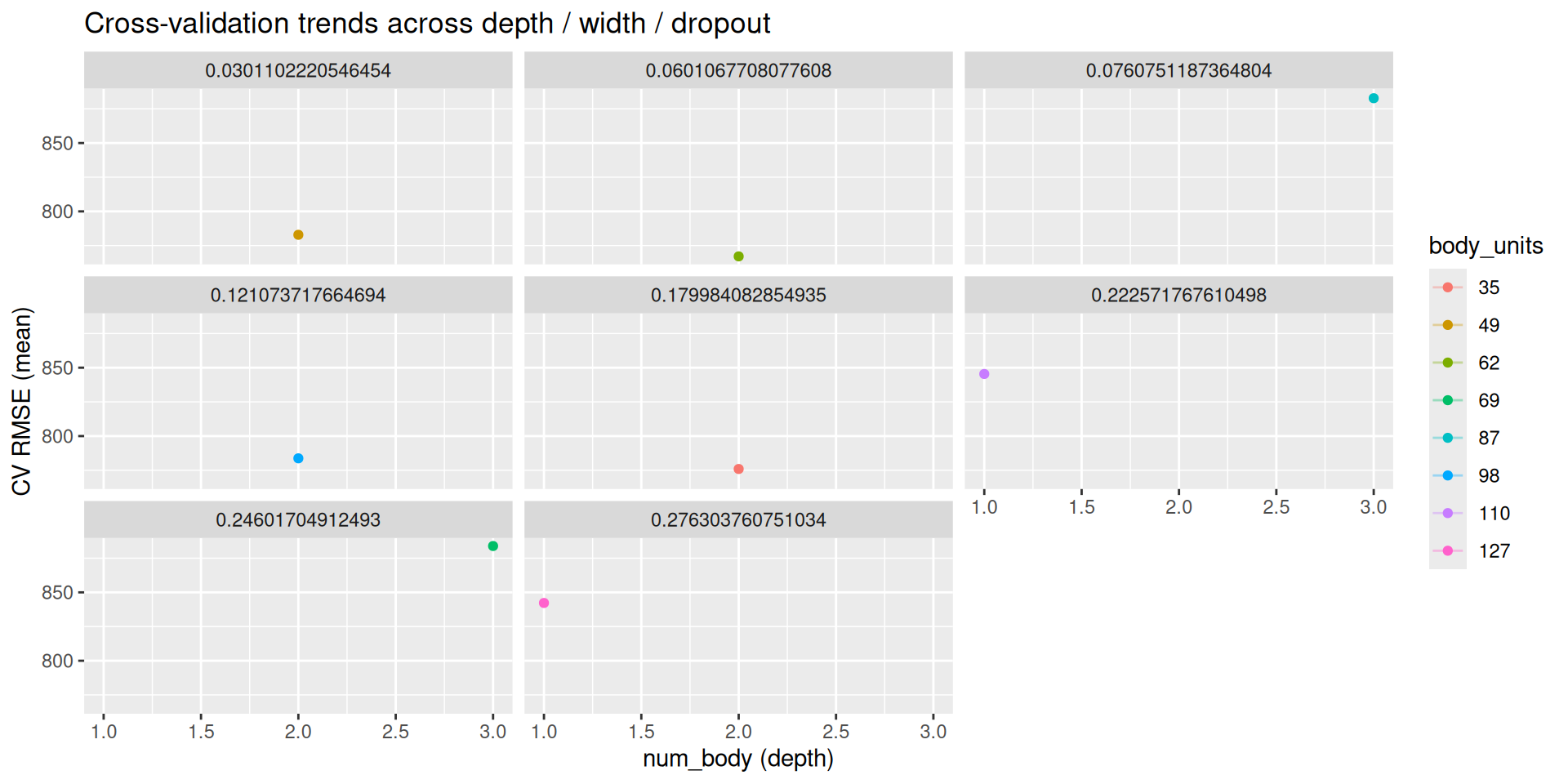
| num_body | body_units | body_dropout | mean | std_err |
|---|---|---|---|---|
| 2 | 62 | 0.060 | 767.101 | 57.202 |
| 2 | 35 | 0.180 | 775.932 | 45.765 |
| 2 | 49 | 0.030 | 782.881 | 51.891 |
| 2 | 98 | 0.121 | 783.726 | 54.377 |
| 1 | 127 | 0.276 | 842.246 | 45.535 |
Results (Diamonds): CV — Plot
Results (Diamonds): Test — Table
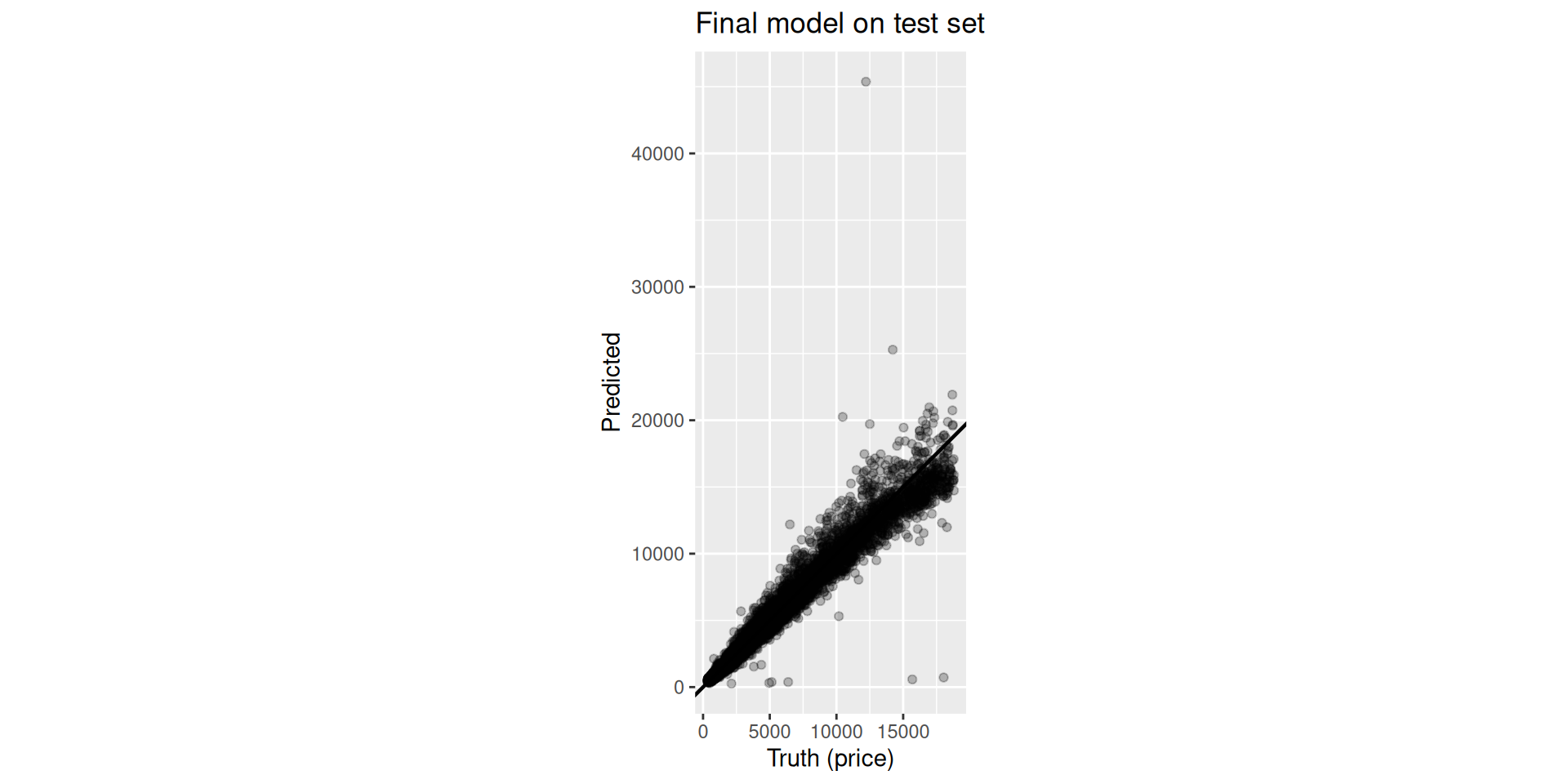
| .metric | .estimate |
|---|---|
| rmse | 736.1172 |
| mae | 349.0455 |
| rsq | 0.9660 |
Results (Diamonds): Test — Plot
Debugging: compile_keras_grid()
# A tibble: 2 × 5
  num_body body_units body_dropout compiled_model
     <dbl>      <dbl>        <dbl> <list>
1        3        -10          0.2 <NULL>
2        6        128          0.2 <keras.src.models.sequential.Sequential>
# ℹ 1 more variable: error <chr>Functional API: Blocks + Graph
Blocks receive tensors, not models
input_block <- function(input_shape) {
  layer_input(shape = input_shape,
              name = "features")
}

dense_block <- function(tensor,
                        units = 64,
                        dropout = 0.0) {
  tensor |>
    layer_dense(units = units,
                activation = "relu") |>
    layer_dropout(rate = dropout)
}

concat_block <- function(input_a, input_b) {
  layer_concatenate(list(input_a, input_b))
}

output_block <- function(tensor, num_classes) {
  tensor |>
    layer_dense(units = num_classes,
                activation = "softmax")
}
inp_spec() wires outputs to inputs by name
create_keras_functional_spec(
  model_name = "attrition_towers",
  layer_blocks = list(
    main_input = input_block,
    tower_a    = inp_spec(
                   dense_block,
                   "main_input"),
    tower_b    = inp_spec(
                   dense_block,
                   "main_input"),
    joined     = inp_spec(
                   concat_block,
                   c(input_a = "tower_a",
                     input_b = "tower_b")),
    output     = inp_spec(
                   output_block,
                   "joined")
  ),
  mode = "classification"
)Attrition Workflow
library(tidymodels)
library(modeldata)
data(attrition)

attr_split <- initial_split(attrition, strata = Attrition)
attr_train <- training(attr_split)

attr_rec <- recipe(Attrition ~ ., data = attr_train) |>
  step_zv(all_predictors()) |>
  step_dummy(all_nominal_predictors()) |>
  step_normalize(all_numeric_predictors())

attr_spec <- attrition_towers(
  tower_a_units = tune(),
  tower_b_units = tune(),
  fit_epochs    = 20
) |> set_engine("keras")

attr_wf <- workflow() |> add_recipe(attr_rec) |> add_model(attr_spec)

params <- extract_parameter_set_dials(attr_wf) |>
  update(tower_a_units = dials::hidden_units(c(16, 128)),
         tower_b_units = dials::hidden_units(c(16, 128)))

res <- tune_grid(attr_wf,
                 resamples = vfold_cv(attr_train, v = 3, strata = Attrition),
grid = grid_latin_hypercube(params, size = 12))Results (Attrition): CV — Table
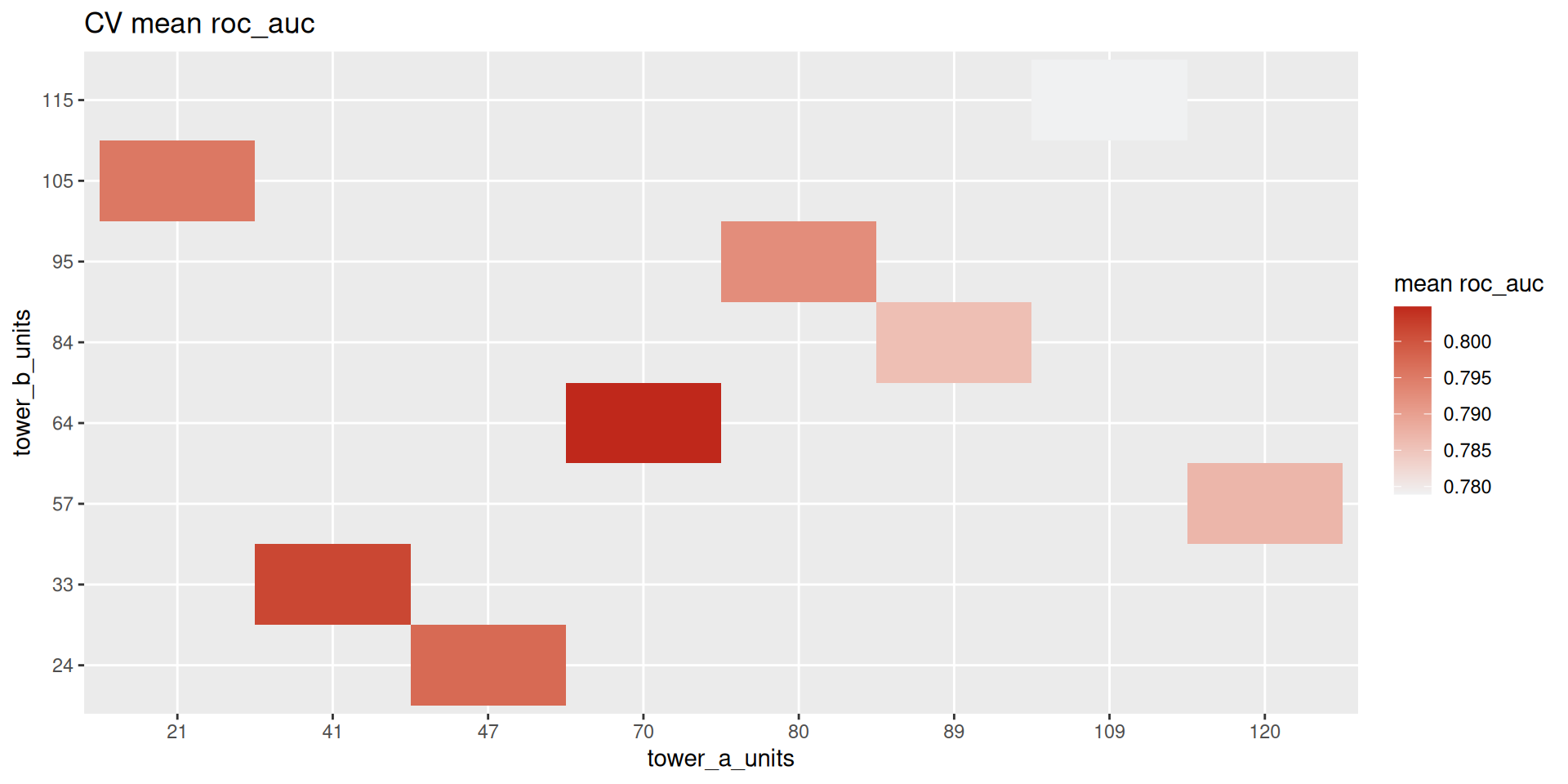
| tower_a_units | tower_b_units | mean | std_err |
|---|---|---|---|
| 70 | 64 | 0.8048 | 0.0218 |
| 41 | 33 | 0.8017 | 0.0239 |
| 47 | 24 | 0.7974 | 0.0185 |
| 21 | 105 | 0.7955 | 0.0278 |
| 80 | 95 | 0.7926 | 0.0219 |
Results (Attrition): CV — Plot
Results (Attrition): Test — Table
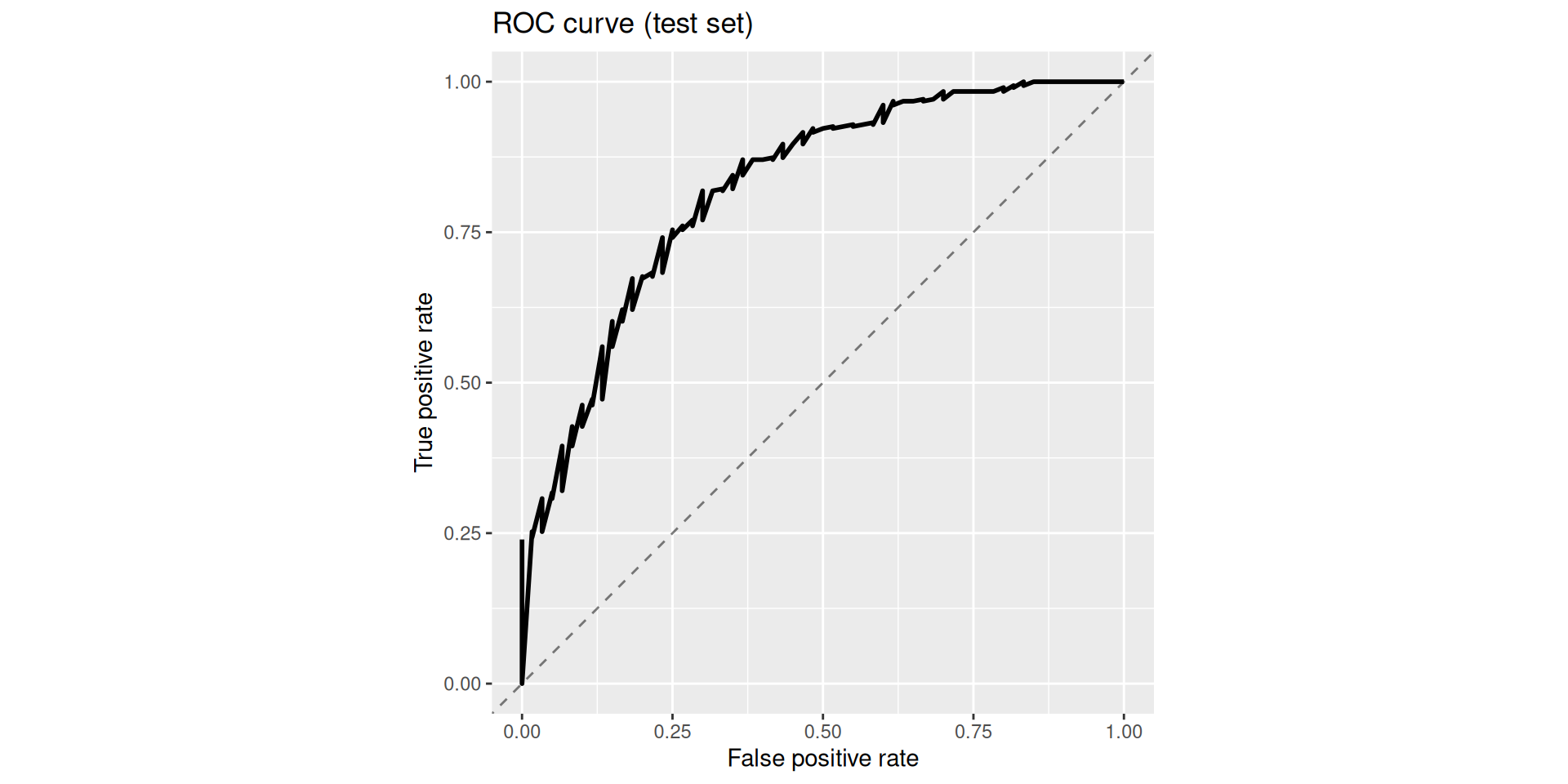
| .metric | .estimate |
|---|---|
| accuracy | 0.8699 |
| roc_auc | 0.8232 |
Results (Attrition): Test — Plot
Practical Tips & Trade-offs
To avoid pain
- Always run
compile_keras_grid()before tuning - Keep blocks small and testable, isolate errors with 2–3 blocks
- Tune structure (depth/width) first; training hyperparameters later
- Keep search spaces reasonable, depth × width explodes fast
Why it is worth it
- Workflow parity —
recipes,workflows,tunework exactly like withglmnet - Reproducibility — topology is code; version-control your architecture
- Extensibility — wrap any Keras layer (Transformers, RNNs) into a block
Resources

kerasnip v0.1.0.900